"You're probably just anxious."
Thanks. This very helpful feedback is one of the most common things women hear when they describe a constellation of symptoms: racing thoughts, disrupted sleep, a sense of dread without a clear trigger, emotional reactivity that feels disproportionate, heart palpitations, sudden overwhelm. The anxiety explanation isn't always wrong. But it's almost always incomplete, and when it becomes the final answer, it stops the investigation that would find what's actually driving the picture.
Progesterone, GABA, and the nervous system
Progesterone is not just a reproductive hormone. When metabolized to its active neurosteroid form, allopregnanolone, it acts as a positive allosteric modulator of GABA-A receptors: the same receptor system targeted by benzodiazepines. When progesterone is low, or when its conversion to allopregnanolone is impaired, GABA signaling is reduced. The result is a nervous system that is less able to regulate arousal, more reactive to stressors, and more prone to what gets labeled anxiety: racing thoughts, difficulty winding down, hypervigilance, disrupted sleep.
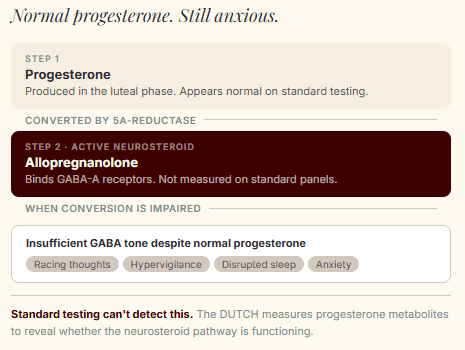
This mechanism is distinct from estrogen dominance or low estrogen. A woman can have progesterone levels that appear within range on a blood draw while the conversion to allopregnanolone is insufficient, producing significant neurological symptoms that a circulating progesterone result would never reveal.
Estrogen, serotonin, and cycle timing
Estrogen modulates serotonin synthesis, receptor density, and reuptake. When estrogen drops after ovulation in the luteal phase, serotonin availability decreases. For women with low progesterone relative to estrogen, or with estrogen that fluctuates significantly across the cycle, this produces mood instability and anxiety symptoms that track precisely with hormonal timing. When anxiety is worse in the two weeks before menstruation and reliably improves after it starts, that's a clinical signal, not a psychological one.
How cortisol closes the loop
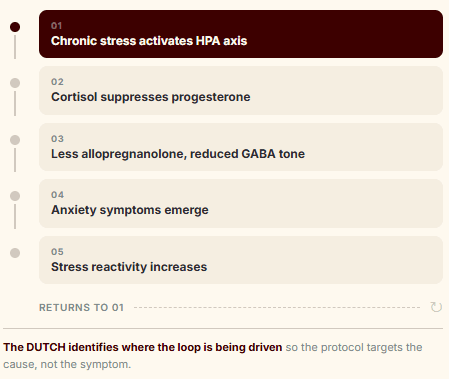
Chronic HPA axis activation doesn't just produce its own anxiety-adjacent symptoms. It actively suppresses progesterone production, which compounds the GABA deficit described above. This is the feedback loop that makes hormonally-driven anxiety self-reinforcing: stress dysregulates cortisol, cortisol suppresses progesterone, low progesterone reduces GABA tone, reduced GABA tone increases stress reactivity. Around it goes.
What the DUTCH adds to this picture
The DUTCH Complete measures neurotransmitter metabolites for dopamine and epinephrine alongside the full hormone panel. This matters because adrenal-driven epinephrine excess produces physical anxiety symptoms (palpitations, hypervigilance, sleep disruption) that are indistinguishable from psychological anxiety without testing. The organic acid markers for B6 and glutathione provide additional context, since both are cofactors in neurotransmitter synthesis and are frequently depleted in women with chronic stress loads.
Reading these markers alongside the cortisol pattern, the progesterone-to-estrogen ratio, and the androgenic pathway gives a complete picture of which part of the system is driving the presentation. That specificity matters because the interventions are not interchangeable. Targeted progesterone support addresses the GABA deficit. Adrenal support addresses the cortisol-suppression loop. Estrogen metabolism optimization addresses the serotonin picture. Getting the right protocol requires knowing which of these is primary, and in what combination.
"Manage your stress" is not a protocol. Neither is "it's probably just anxiety." The DUTCH Complete is where the real answer starts.