
Most women who come to SeshDx aren't new to trying. They've tracked macros, cut sugar, overhauled their sleep, added supplements, reduced alcohol, increased protein, and hired trainers. And they still feel like they're running on empty, can't shift weight, and wake up exhausted no matter how many hours they got.
What they're almost never told is that those symptoms, all of them together, are a textbook presentation of metabolic dysfunction. Not a motivation problem. Not an aging problem. A system problem that standard medicine isn't designed to find.
The reason it goes unfound is rarely that the dysfunction isn't there. It's that the tests being used to look for it aren't sensitive enough to see it.
"Normal" doesn't mean optimal
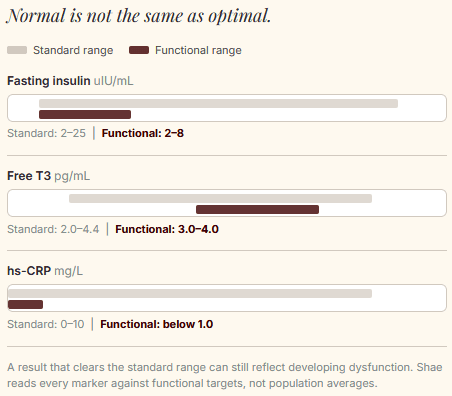
Reference ranges are built on population averages. They tell you whether a marker falls within the range seen in a large cross-section of people, including people who are metabolically unwell. Normal means average. It does not mean functioning well.
The gap between normal and optimal is where most women with metabolic dysfunction are living. Their glucose cleared the range. Their TSH was technically fine. Their inflammation marker wasn't tested at all. And so they're told everything looks good, while their body is telling them clearly and consistently that something is wrong.
Functional ranges are tighter, evidence-based targets that reflect what markers look like in people who are genuinely well: stable energy, stable body composition, mental clarity, regulated mood. Reading labs against functional ranges rather than population averages is what allows dysfunction to be identified before it becomes disease, and addressed when it's still fully reversible.
What is your metabolism, actually?
Metabolism isn't a calorie-burning rate. It's the entire network of biological processes the body uses to convert food into usable energy, regulate blood sugar, manage inflammation, maintain hormonal balance, and keep every major organ system running. When any part of that network falls out of optimal range, whether insulin signaling, thyroid output, lipid processing, or inflammatory load, the rest of the system compensates. That compensation is what produces the symptoms.
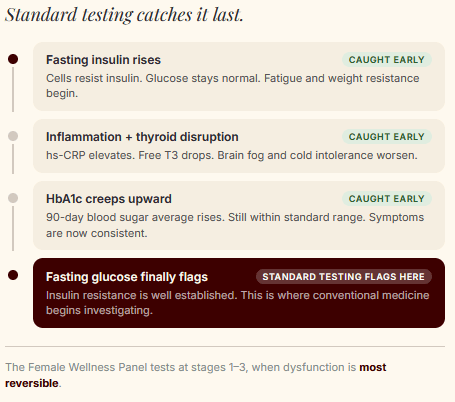
The cascade usually starts quietly. Fasting insulin creeps up. Inflammation ticks higher. Thyroid conversion slows. Blood sugar swings become more pronounced. Each shift is individually subtle enough to clear a standard reference range. Together they create a picture that's anything but subtle, and yet somehow never gets flagged.
So what metabolic markers tell the real story?
Standard metabolic testing typically checks fasting glucose and, occasionally, TSH. What that misses is where the functional picture actually lives.
Fasting insulin is one of the most clinically important metabolic markers and one of the most rarely tested. Insulin resistance begins years before glucose levels shift. By the time fasting glucose is elevated, insulin resistance is typically well established. Testing fasting insulin catches the dysfunction early, when it's most reversible.
HbA1c provides a 90-day average of blood sugar control, context a single glucose reading can never give. A woman can fast before her labs, show normal glucose, and still have an HbA1c reflecting chronic blood sugar elevation throughout her daily life.
Free T3 and free T4 are the active thyroid hormones that actually enter cells and drive metabolic function. Most panels stop at TSH, the pituitary signal that tells the thyroid to produce hormones, without checking whether production and conversion are actually happening. Subclinical hypothyroidism, where TSH sits within the reference range but free T3 is low, is one of the most consistently missed drivers of fatigue, weight changes, brain fog, and cold intolerance in women.
High-sensitivity CRP measures systemic inflammation at a level of sensitivity that standard CRP testing doesn't reach. Chronic low-grade inflammation is both a cause and a consequence of metabolic dysfunction. It drives insulin resistance, disrupts thyroid conversion, and accelerates hormonal imbalance. It can be present for years, producing symptoms, without ever triggering a flag on a standard panel.
Lipid markers tell a different story when read alongside insulin, inflammation, and thyroid data. Dyslipidemia is frequently downstream of insulin resistance and thyroid dysfunction, not a primary problem. Treating it in isolation, without addressing the metabolic drivers, produces limited results.
What the Female Wellness Panel looks at
The Female Wellness Panel is built to close the gap between normal and optimal. In a single blood draw, it evaluates blood sugar regulation through glucose, fasting insulin, and HbA1c; thyroid function through TSH, free T3, and free T4; systemic inflammation through hs-CRP; hormonal status through estrogen, FSH, and DHEA; cardiovascular and lipid markers in the context of the full metabolic picture; and liver and kidney function through ALT, AST, and kidney markers, which are critical baseline data when building a supplementation or dietary protocol.
Together, these markers give a functional picture of how metabolism is actually performing, not just whether it clears a threshold.
What Shae finds when she reviews your results
When results come in, Shae reviews every marker against functional ranges, not population averages, and delivers a written interpretation of what the data shows: where dysfunction is present, how the markers are interacting with each other, and what's likely driving the symptoms. That interpretation is the thing most women have never received. Not a flagged result. Not a "your labs are normal." A coherent explanation of what the body is actually doing.
From there, she builds a protocol around what's showing: nutrition targets, movement guidance, supplementation, and where indicated, referral for physician-reviewed clinical intervention. The goal is never to manage numbers. It's to understand why they're off, address the root cause, and measure what changes.
That's what normal labs never gave you. That's what this does.