Most women with functional nutrient depletion are already taking supplements. Often several. A multivitamin, extra vitamin D, some iron because their energy hasn't improved, maybe magnesium because they read it helps with sleep. They're doing what they've been told to do. And frequently, those supplements are doing little, some are redundant, and at least one is actively working against them.
The problem isn't supplementation. It's supplementing without knowing what you're actually depleted in, at what level, and through which mechanism. A multivitamin is a population-average formulation built to cover common deficiencies at doses unlikely to cause harm across a broad range of people. That design goal is incompatible with addressing specific cellular deficiencies in a specific woman whose absorption, utilization, and depletion profile is shaped by her individual gut function, hormonal status, stress load, genetics, and medication history.
When supplements compete with each other
Nutrient competition is real, clinically significant, and almost never discussed in general wellness recommendations.
Calcium and magnesium share intestinal transport pathways. High-dose calcium supplementation, one of the most common recommendations in women's health, directly impairs magnesium absorption. A woman supplementing calcium for bone health while experiencing symptoms of magnesium depletion (muscle tension, poor sleep, blood sugar instability, anxiety) may be preventing her own recovery without knowing it.
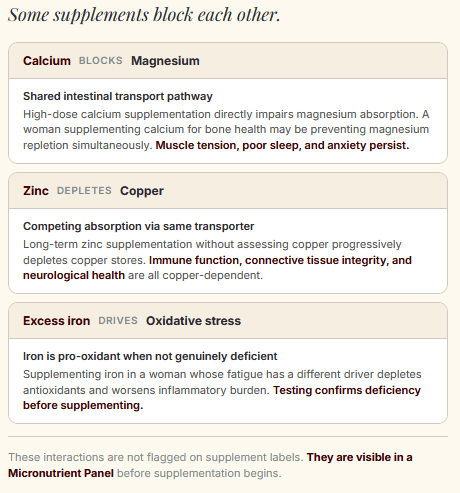
Zinc and copper compete for absorption through the same mechanism. Supplementing zinc without assessing copper status can progressively deplete copper over time, with downstream consequences for immune function, connective tissue integrity, and neurological health.
Iron is one of the most commonly supplemented minerals in women, and one of the most problematic to take without confirmed cellular deficiency. Excess iron is pro-oxidant: it drives oxidative stress and depletes antioxidants, compounding exactly the kind of inflammatory burden described in the antioxidant depletion post. Supplementing iron in a woman whose fatigue has a different driver (thyroid, cortisol, cellular CoQ10) actively worsens her oxidative load while failing to address the actual cause.
When fat-soluble vitamins accumulate
Vitamins A, D, E, and K are fat-soluble. Unlike water-soluble vitamins, they accumulate in tissue and can reach toxic levels with chronic over-supplementation. Vitamin D is the most commonly over-supplemented nutrient in women's health, often taken at high doses without cofactor support. Vitamin D supplementation without adequate K2 can drive calcium into arterial walls rather than bone, producing cardiovascular risk while the intention was bone support. This is not a theoretical edge case. It is a known interaction that testing and informed protocol design prevents.
What targeted repletion actually looks like
When Shae reviews a Micronutrient Panel, she's not building a supplement stack from symptoms or general wellness principles. She identifies which nutrients are depleted at the cellular level, in what degree, through which likely mechanisms, then recommends specific forms, doses, and timing based on what the data is showing.
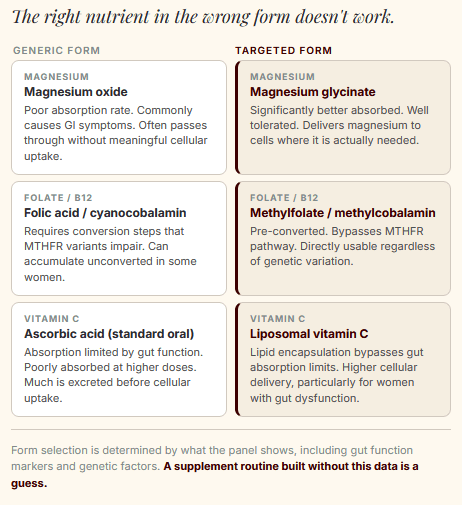
Magnesium glycinate rather than magnesium oxide, because glycinate is significantly better absorbed and far less likely to cause gastrointestinal symptoms. Methylated B vitamins for women with MTHFR variants that impair folate and B12 conversion. Liposomal vitamin C for women with gut dysfunction that limits standard oral absorption. These distinctions matter. A supplement in the wrong form, taken at the wrong time, without the cofactors it depends on, produces a fraction of the clinical benefit of the same nutrient prescribed correctly.
Why food always comes first
Supplementation fills gaps that food cannot close on its own, and addresses absorption issues that dietary changes alone cannot overcome. But it is always secondary to understanding why the depletion is happening. If a woman is depleted in magnesium despite eating magnesium-rich foods, the relevant question is not what dose of magnesium to take. It is why absorption is impaired, and what addressing that root cause requires.
A supplement list is a response to a symptom. A protocol is a response to data. The Micronutrient Panel is what makes the difference between the two possible.