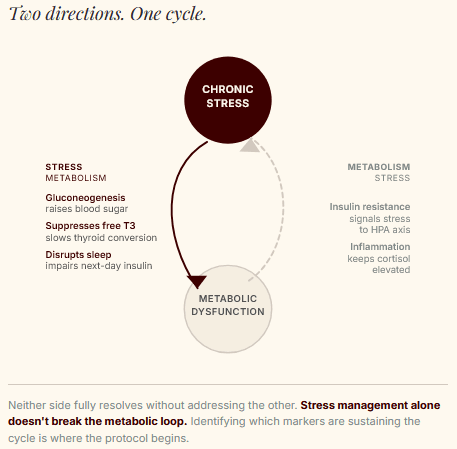
Chronic stress and metabolic dysfunction are not two separate problems that happen to produce similar symptoms. They are two directions of the same loop. Stress drives metabolic dysfunction. Metabolic dysfunction amplifies the physiological stress response. Once that loop is running, neither side can fully resolve without addressing the other. And just telling someone to manage their stress, without identifying the metabolic state that's keeping the loop active? That addresses neither.
What cortisol actually does to metabolism
Cortisol is a glucocorticoid. In acute stress situations, it serves a precise function: it signals the liver to release glucose into the bloodstream through gluconeogenesis, providing fast fuel for the stress response. In chronic stress, that same mechanism runs continuously. The liver keeps releasing glucose. Insulin keeps responding. Over time, cells become progressively less responsive to insulin's signal which signifies the early stages of insulin resistance, developing quietly while fasting glucose still looks normal.
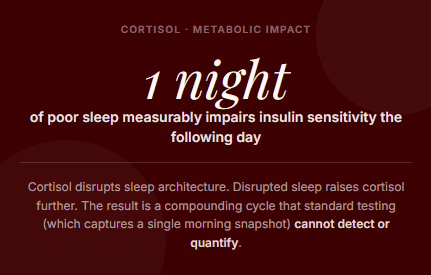
Cortisol also directly suppresses thyroid hormone conversion, reducing the active free T3 available to cells. It elevates systemic inflammation. And it disrupts sleep architecture, which matters metabolically: a single night of poor sleep measurably impairs insulin sensitivity the following day. The worse the metabolic state, the more the body perceives itself as under physiological stress. The higher the perceived stress, the more cortisol. The more cortisol, the more the metabolic state deteriorates.
This is why "just reduce your stress" produces limited results. The metabolic loop is generating its own stress signal independent of what's happening in life.
The symptom overlap is not coincidental
Fatigue, weight gain, brain fog, mood instability, poor sleep, cravings: these are the symptoms of chronic stress. They are also the symptoms of insulin resistance, subclinical hypothyroidism, and chronic inflammation. The overlap isn't coincidence. The mechanisms are the same. Cortisol-driven blood sugar dysregulation and insulin resistance-driven blood sugar dysregulation produce identical presenting symptoms, because they're the same physiological event reached from different directions.
This is what makes "it's probably just stress" such a durable non-answer. It gestures at something real without ever specifying what's actually measurable, and it forecloses the investigation that would.
What testing adds that stress management can't
The Female Wellness Panel doesn't replace the conversation about stress. It gives that conversation a specific, measurable foundation. Rather than re-covering each marker here (see our earlier post on what the panel tests and why), what matters is what testing adds: specificity. Is insulin resistance already developing? Is free T3 low enough to be driving the fatigue and mood instability? Is inflammation elevated in a way that's sustaining the HPA activation? These questions have answers. Those answers change what the protocol looks like.
Breaking the loop
When Shae reviews a Female Wellness Panel, she's looking for the physiological patterns driving the cycle and the markers keeping it active. The protocol that follows is built around that: targeted nutrition to stabilize blood sugar and reduce the cortisol-glucose cycle, support for thyroid conversion where the data shows it's impaired, and inflammation reduction that gives the HPA axis room to regulate. Not a stress management plan. A metabolic intervention that addresses the physiology keeping the stress response active.
That's a different thing entirely.