If you’ve been digging into our blogs you may be familiar with several possible drivers of fatigue, brain fog, mood instability, and hair loss: hormonal imbalance, HPA axis dysregulation, metabolic dysfunction, insulin resistance. All of those are real. All of them have testing behind them.
In this, we cover the layer that compounds all of them: cellular nutrient depletion. Not deficiency in the clinical sense, where serum levels fall below a reference range. Functional depletion, where nutrients are circulating normally in the bloodstream while inside the cells where they're actually needed, the supply is insufficient to run the processes that depend on them.
The distinction matters because cellular depletion produces identical symptoms to every other driver in this series, but through a completely different mechanism. And it won't respond to hormonal support, metabolic intervention, or stress management if the underlying cellular insufficiency isn't addressed alongside them.
What happens when energy production fails at the cellular level?
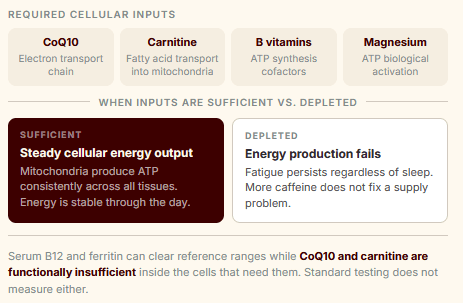
Energy is not produced in the bloodstream. It's produced inside cells, in the mitochondria, through a nutrient-dependent chain of reactions. CoQ10 is essential for electron transport in that chain. Carnitine shuttles fatty acids into the mitochondria to be burned as fuel. B vitamins (B1, B2, B3, B5) are cofactors at multiple steps in ATP synthesis. Magnesium is required for the ATP molecule itself to be biologically active.
When any of these are depleted at the cellular level, energy output declines. Not because of sleep quality, fitness level, or motivation. Because the machinery that produces energy is missing components. Serum B12 and ferritin can clear their reference ranges while CoQ10 and carnitine are functionally insufficient inside the cells that need them. This is why fatigue that doesn't respond to sleep is one of the most consistent presentations of cellular depletion: it's a supply problem the bloodstream isn't showing.
When cognitive symptoms have a nutritional driver
Brain fog, slow processing, and word retrieval problems have appeared earlier in our blogs as presentations of cortisol-driven hippocampal suppression and blood sugar dysregulation. The nutritional layer adds additional mechanisms that compound those. B12 is essential for myelin sheath maintenance and neurological signalling. B6 is a direct precursor to serotonin, dopamine, and GABA. Magnesium regulates NMDA receptors involved in memory and learning. Choline is required for acetylcholine synthesis, the neurotransmitter most directly associated with cognitive function.
A woman dealing with HPA axis dysregulation and cellular B6 depletion simultaneously has two independent drivers of cognitive symptoms. Addressing one without the other produces partial results.
When immune function degrades
Recurring illness, infections that linger, and wounds that heal slowly are a nutritional problem before they are an immune problem. Zinc, selenium, vitamin C, and vitamin D are the primary nutritional drivers of immune cell production and function. Glutamine is the primary fuel source for both intestinal cells and immune cells, and its depletion impairs gut barrier integrity and immune response at the same time. Glutathione, the body's master antioxidant, is essential for immune cell activity. When these markers are depleted at the cellular level, immune function degrades in ways that supplementing vitamin C alone will not address, because the problem is cellular availability, not intake.
When hair loss has more than one driver
Hair thinning driven by DHT and androgen excess was covered in the hormone dysregulation posts. The nutritional picture adds separate mechanisms that frequently coexist. Zinc disrupts the hair growth cycle and accelerates follicle miniaturization when depleted. Ferritin depletion (distinct from serum iron) is one of the most well-documented nutritional causes of female hair loss, often present before iron levels shift. Selenium and vitamin D both affect follicle health in ways standard testing never evaluates. A woman whose hair loss has an androgen component may also have a nutritional component. Treating only one is a partial answer.
When muscle symptoms are mineral problems
Muscle cramping, persistent tension, soreness that lingers, and exercise intolerance map directly onto mineral depletion. Magnesium governs muscle contraction and relaxation, nerve signal transmission, and lactic acid clearance from muscle tissue. Its depletion produces cramping and tension that stretching doesn't fix, because the problem is not mechanical. Carnitine depletion produces exercise intolerance and slow recovery that is almost invariably attributed to fitness level or hormonal status rather than the fatty acid transport failure it actually represents.
When mood symptoms have a nutritional root
Mood instability, anxiety, and low mood have appeared in this series as presentations of hormonal and blood sugar dysregulation. The nutritional layer adds further mechanisms. B6 depletion reduces production of serotonin and GABA. Magnesium deficiency is independently associated with increased anxiety and depressive symptoms. Inositol, a lesser-known marker assessed by the Micronutrient Panel, plays a direct role in serotonin and insulin signalling, and its depletion has been linked to mood dysregulation and panic symptoms. These are not character traits or stress responses. They are correctable deficiencies.
When inflammation doesn't resolve
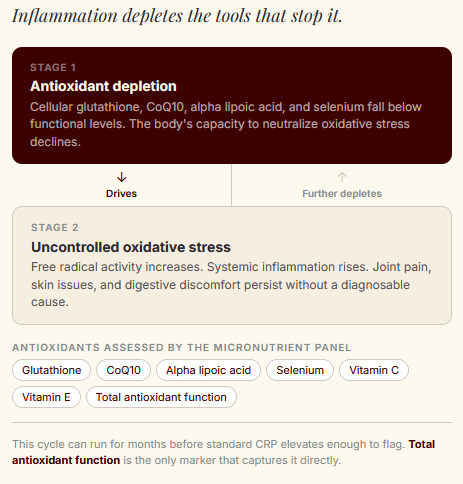
Chronic low-grade inflammation (joint pain, skin issues, digestive discomfort, systemic irritation without a clear cause) is frequently driven by antioxidant depletion. When cellular glutathione, alpha lipoic acid, CoQ10, and selenium are insufficient, the body's capacity to neutralize oxidative stress declines. Oxidative stress drives inflammation. Inflammation depletes antioxidants further. The cycle compounds quietly, producing symptoms well before standard CRP is elevated enough to flag. The Micronutrient Panel's total antioxidant function marker assesses this picture directly, something no standard panel includes.
The compounding picture
Every symptom in this post has also appeared in earlier posts, attributed to hormonal, metabolic, or stress-related drivers. That's not a contradiction. Multiple drivers are frequently active simultaneously. The same fatigue can have a cortisol component, a thyroid component, and a CoQ10 component, all running at the same time. The same mood instability can reflect HPA axis dysregulation and B6 depletion together. Testing each system in isolation and treating only what shows produces incomplete results. Testing comprehensively, and reading how the systems interact, is what produces a protocol that actually works.
That's what the full SeshDx panel suite is designed to do.