Most women experiencing metabolic dysfunction aren't told that's what's happening. They're told they're stressed, that they need to sleep more, that it's perimenopause, that their labs are normal… the list goes on. The symptoms get managed individually, each one assigned its own explanation, and the underlying pattern never gets named.
The pattern has a name. And it shows up in predictable ways once you know what to look for.
Your energy crashes on a schedule
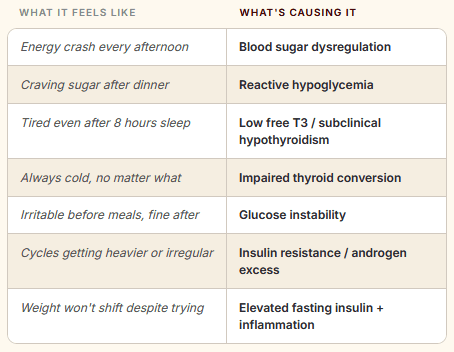
Fatigue that arrives at the same times every day, like mid-morning, after lunch, by 3pm, isn't random tiredness. It's the brain responding to blood sugar dysregulation. The brain is the most glucose-dependent organ in the body, and when glucose signaling is impaired, it experiences dropping blood sugar as an emergency. The physiological response is a surge in adrenalin to raise blood sugar back up, which then triggers an insulin response that drops it again. The result is the roller-coaster pattern most women describe as their "normal" energy level: high after coffee, crashing before noon, wired in the evening when they should be winding down.
Fasting insulin and HbA1c testing make this pattern visible. A single fasting glucose result can't.
You crash after meals and reach for something sweet
A sharp post-meal energy drop, followed by intense cravings for sugar or fast carbohydrates, is a measurable blood sugar event. When glucose regulation is impaired, blood sugar rises quickly after eating and then drops significantly, sometimes below baseline. That drop drives cravings: the brain perceives the fall as a threat and signals urgency for fast-acting glucose. This isn't a willpower problem. It's a physiological signal that the regulation system needs support, and it's identifiable on functional metabolic testing before it progresses further.
Your cold intolerance and persistent fatigue share a root
Always cold when no one else is. Exhausted despite adequate sleep. These two symptoms frequently share a single driver: suboptimal free T3. The thyroid regulates both thermogenesis and cellular energy production, and when free T3 is low (which can occur even when TSH sits within the standard reference range), both cold intolerance and fatigue present clearly and consistently. Standard thyroid testing stops at TSH. The Female Wellness Panel goes further, measuring free T3 and free T4 to assess whether the thyroid is actually producing and converting hormones, not just being signalled to do so.
Your cycle changes are metabolic signals, not just hormonal ones
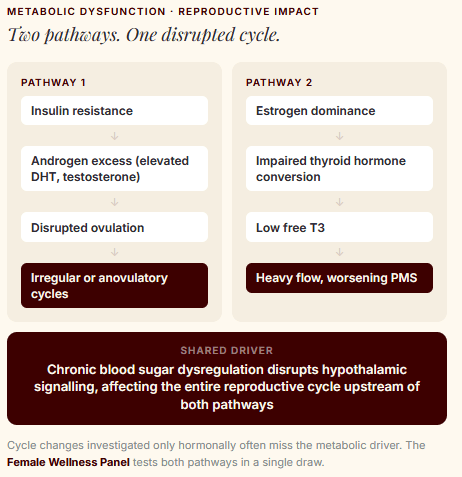
Changes in cycle length, flow, or premenstrual symptoms are often read as purely hormonal. The metabolic connection is less commonly discussed and more commonly missed. Insulin resistance drives androgen excess, which disrupts ovulation and shortens or lengthens the luteal phase. Estrogen dominance (which develops when progesterone is low relative to estrogen) directly impairs thyroid hormone conversion, compounding the thyroid picture. And chronic blood sugar dysregulation affects the hypothalamic signalling that regulates the entire reproductive cycle.
A woman whose cycles have become irregular, heavier, or increasingly symptomatic over the past one to three years may be experiencing a metabolic shift present in reproductive language. Investigating it metabolically, rather than only hormonally, often reveals the driver that hormonal intervention alone won't fully address.
Your mood instability tracks with meals, not circumstances
Irritability that arrives predictably before meals. Anxiety that lifts after eating. Low mood in the late afternoon that improves after dinner. When mood changes track with food timing rather than life circumstances, blood sugar dysregulation is a primary suspect. Thyroid dysfunction compounds the picture: free T3 has direct effects on serotonin signalling and neural function, producing mood and cognitive symptoms that are frequently attributed to anxiety or depression without the metabolic driver ever being investigated.
These symptoms aren't separate problems. They're the same system, running out of optimal range, expressing itself in multiple ways simultaneously. The Female Wellness Panel maps that system completely, including blood sugar, thyroid, inflammation, hormonal status, and lipid function, so Shae can interpret what's actually driving the pattern and build a protocol around the root, not the branches.