Most women who eventually find their way to functional hormone testing have already been through the standard process. Blood was drawn. A panel was run. Everything came back within range. And yet the symptoms didn't go anywhere.
The disconnect isn't imagined. It's methodological. Standard hormone panels measure circulating levels against population reference ranges. What they don't measure is where the real dysfunction lives: in hormone metabolism, diurnal cortisol patterns, and the downstream markers that reveal how hormones are actually being processed. (For a full breakdown of what the DUTCH Complete measures and why it differs from standard testing, check it out here.)
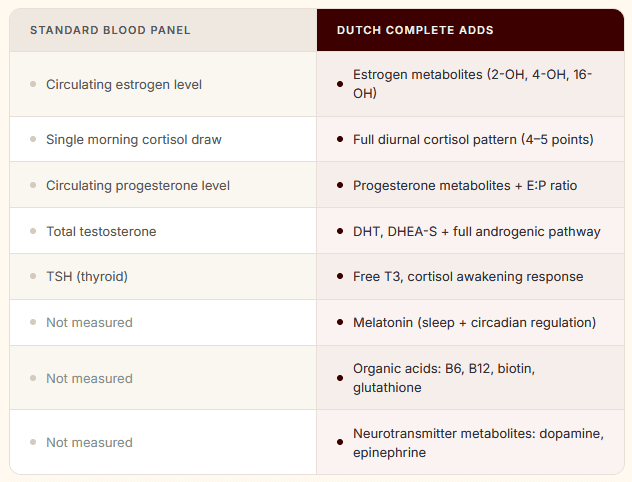
These are the seven signs seen most consistently in women with hormone dysregulation, and what's actually driving each one.
1. You can't fall asleep, or you wake at 3am and can't get back down
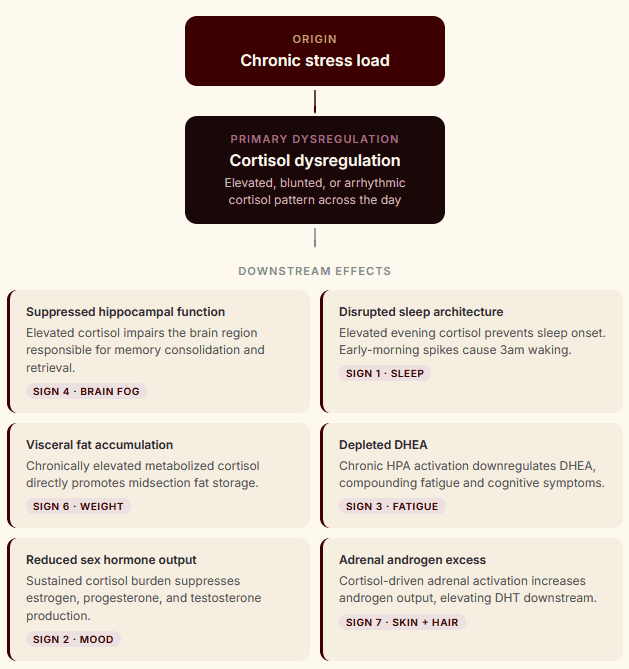
Difficulty falling asleep is frequently tied to elevated evening cortisol: instead of declining toward bedtime, the cortisol curve stays high, keeping the nervous system activated. Waking between 2 and 4am is commonly associated with a cortisol spike in the early morning hours, often driven by low blood sugar or HPA axis dysregulation. Low progesterone compounds both patterns. Progesterone has a calming, GABA-promoting effect on the nervous system, and when it's low relative to estrogen, sleep architecture suffers. None of this shows on a morning cortisol draw.
2. Your mood shifts in ways that feel physical, not emotional
Irritability that arrives predictably in the luteal phase. Anxiety that appears mid-afternoon for no discernible reason. Low mood that lifts after eating or a better night's sleep. These are hormonal and metabolic events presenting as emotional symptoms, and they're frequently misattributed to stress or depression without being investigated at the hormonal level. Estrogen directly modulates serotonin. Progesterone affects GABA. When these systems are off, mood follows. The fix is rarely a mindset shift.
3. You're exhausted, but your iron and thyroid are fine
Fatigue that persists despite normal iron, normal TSH, and adequate sleep is one of the most diagnostically abandoned presentations in women's health. When the obvious markers check out, the investigation often stops. A blunted or dysregulated cortisol awakening response is a well-documented driver of persistent low energy that blood testing doesn't capture. Low DHEA compounds the picture. Suboptimal free T3 (missed when the panel stops at TSH) reduces cellular energy production. The DUTCH maps cortisol pattern and DHEA alongside the full hormone picture, giving a functional explanation for fatigue that standard panels leave blank.
4. You're losing words. Your memory feels unreliable.
Brain fog and memory lapses are among the most distressing and least investigated hormonal symptoms. Chronically elevated cortisol directly suppresses hippocampal function, the brain region most responsible for memory consolidation and retrieval. Declining DHEA (which acts as a neurosteroid, protecting brain tissue from cortisol's catabolic effects) compounds the cognitive impact. This isn't vague or subjective. It's a measurable downstream consequence of HPA axis dysregulation that shows on a functional hormone assessment and not on a standard panel.
5. Your cycles are irregular, heavy, or increasingly symptomatic
Changes in cycle length, flow, or the severity of premenstrual symptoms are among the earliest indicators of underlying hormonal imbalance. A shortening luteal phase suggests declining progesterone. Heavy or prolonged bleeding frequently tracks with estrogen dominance. Worsening PMS (mood changes, bloating, breast tenderness, cramping) maps directly onto the estrogen-to-progesterone ratio in the two weeks before menstruation. These are measurable, testable patterns. They're not an inevitable feature of having a cycle.
6. You're gaining weight around the midsection despite eating well
Unexplained visceral fat accumulation is rarely just a calorie problem. Chronically elevated metabolized cortisol directly promotes fat storage in the midsection. Estrogen dominance (estrogen high relative to progesterone) is associated with fat accumulation in the hips, thighs, and abdomen. Low progesterone contributes to water retention. Elevated androgens can shift body composition in ways that diet and exercise alone won't reverse. The DUTCH maps all of these simultaneously, rather than testing each in isolation and missing the interactions between them.
7. Your skin is breaking out and your hair is thinning — and it started in your 30s or 40s
Adult acne along the jawline and chin, combined with hair thinning, often share a root cause: elevated DHT, produced through the 5-alpha reductase pathway from testosterone. Elevated cortisol drives adrenal androgen production. Declining estrogen in perimenopause shifts the androgen-to-estrogen ratio. Low biotin (frequently seen alongside hormonal dysregulation) contributes to the hair loss picture independently. Treating these symptoms topically or with hormonal birth control addresses the surface, not the driver. The DUTCH androgenic pathway assessment identifies whether the source is adrenal, ovarian, or metabolic, which determines what kind of intervention actually works.
These symptoms are real. They have measurable causes. And those causes have specific protocols behind them.