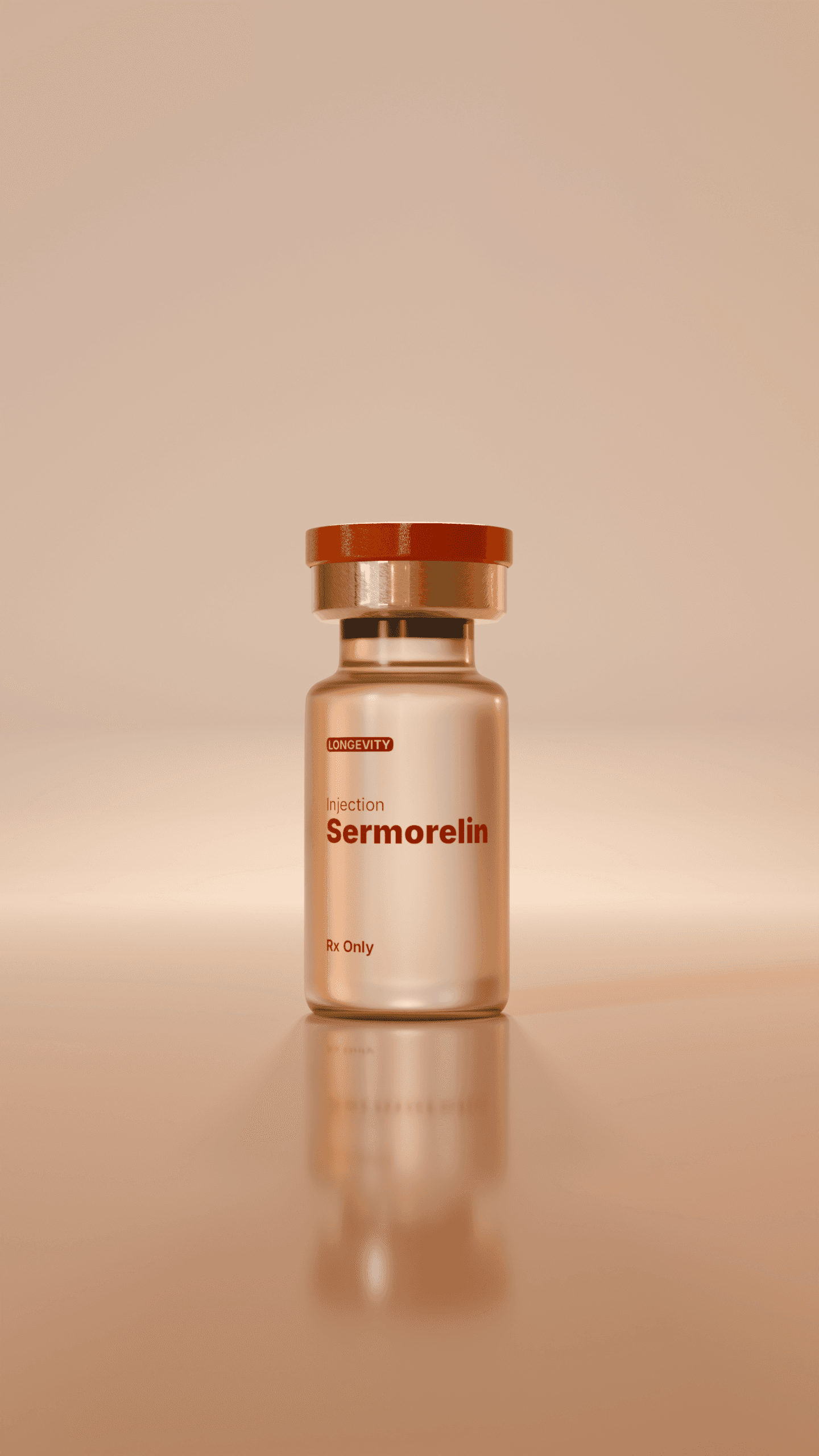
If you've heard anything about growth hormone and felt a little uneasy, good. You should be skeptical of anything that promises to flood your body with something it wasn't making on its own. So let's clear up the most important thing about Sermorelin right away: it doesn't do that.
Sermorelin peptide does not add a single hormone to your body. It helps your body release more of the growth hormone it already makes.
Your body already doing this work
Growth hormone, or GH, is made in your pituitary gland. Your body releases it in natural pulses, mostly during deep sleep. In your twenties, those pulses are strong. As you move through your thirties and forties, they get quieter. You still make GH. You just release less of it, less often.
Less GH shows up in ways you can feel: slower recovery after training, lighter sleep, and a harder time holding the lean muscle you work for.
Said plainly: the hormone isn't missing. The signal to release it has just gotten quieter.
Adding versus releasing: the difference that matters
There is a version of this that does add a hormone. Synthetic HGH is the actual growth hormone, made outside your body and injected in. That is adding. And because you're putting the finished hormone in from the outside, it can override your body's own signals and, over time, quiet your natural production.
Sermorelin takes the opposite approach. It never hands your body a finished hormone at all.
What Sermorelin actually does
Sermorelin is not growth hormone. It's a messenger.
It's a close match to the natural signal your brain already uses to talk to your pituitary, the one that says "release some growth hormone now."
So when Sermorelin goes to work, it taps your pituitary on the shoulder and asks it to release more of what is already stored there. The hormone that ends up in your bloodstream is your own GH, made by your own gland, released in your own natural pulses, mostly while you sleep.
Think of it this way: nothing is being poured in from a foreign bottle. Sermorelin just helps open the tap that is already plumbed into your system.
Why "your own, on your own rhythm" matters
Because Sermorelin works through your body's existing signals, your body keeps the controls.
Your system has its own brakes. When you've released enough, your body naturally slows things back down. Sermorelin nudges that process, it doesn't force it. It works with your feedback loops instead of bulldozing them, which is exactly why it follows your natural rhythm rather than replacing it.
Said plainly: it reminds your body to do something it already knows how to do, then gets out of the way.
Why this matters for women, especially
You train. You eat well. And still, recovery feels slower, sleep feels lighter, and your strength doesn't show up the way it used to. That's not in your head, and it's not a willpower problem. It often lines up with the natural dip in growth hormone that starts in your thirties and forties.
Helping your body release more of its own GH can mean better recovery, deeper sleep, and lean strength that finally keeps pace with the work you're putting in.
And to answer the question women actually ask first: no, this won't make you bulky. Supporting your own growth hormone is about recovery and lean tone, not size.
More of what your own growth hormone does for you
Recovery and lean strength are the headline. But your growth hormone touches more than that, and several of those effects matter in a specific way for women. When you support your own GH, here is what else can come with it.
It helps your body burn fat, especially the stubborn kind.

GH supports the breakdown of stored fat, including the visceral fat that tends to settle around the midsection as your hormones shift. Why it matters for women: that midsection change is often hormonal, not a question of effort, so supporting your own GH gives your training a fairer shot at it.
It supports your bone, not just your muscle.

GH and the growth factors it stimulates help maintain the bone you already have. Why it matters for women: you lose bone density faster with age, especially around menopause, and real strength is built on a frame that can carry it. Training plus healthy GH supports the whole structure, not only the muscle on top.
It supports collagen, skin, and the connective tissue that keeps you training.

GH feeds collagen, which shows up in skin elasticity and, just as importantly for an active woman, in the tendons and joints that absorb the load when you lift. Why it matters for women: stronger connective tissue means better resilience and fewer of the nagging injuries that quietly kill your momentum.
It helps protect lean muscle while you lose fat.

If you're using a GLP-1 like Tirzepatide or Semaglutide to lose weight, some of what comes off can be muscle. Supporting your own GH helps tip that balance back toward fat. Why it matters for women: the goal was never to weigh less, it was to lose fat and keep your strength.
It supports steadier energy and a more like-yourself mood.

Because GH is tied to deep, restorative sleep, more of your own often means you wake up feeling more recovered. Why it matters for women: that "I don't recognize my energy anymore" feeling is real, and a lot of it gets rebuilt while you sleep.
How this works at Sesh Diagnostics
Sermorelin is a prescription, not a supplement you grab off a shelf. Through SeshDx, a licensed clinician reviews your history first, or you can start with labs, and prescribes it only if it's right for you.
That's the point of doing this with us. You can pair Sermorelin with hormone and gut labs that show you why your body feels the way it does, work with a coach, and keep your training and nutrition in the Sesh Fitness App, free with every plan. You start from your own data, not guesswork.
Sermorelin is a prescription medication, and it isn't for everyone. Eligibility is decided by a licensed clinician, the benefits above are associated with healthy growth hormone levels and will vary from woman to woman, and none of it replaces the basics that actually build a strong body: your training, your sleep, and your nutrition. It's one tool inside a bigger system, not a shortcut around the work.
But that's also what makes it worth understanding. Your body spent decades learning how to repair, recover, and get strong. Sermorelin is simply a way to remind it.
See if Sermorelin is right for you →
Sources
Sermorelin, an overview (GHRH 1-29 analog; binds anterior pituitary GHRH receptors to stimulate endogenous GH; preserves pulsatile secretion and feedback; less effective than GH itself). ScienceDirect Topics. https://www.sciencedirect.com/topics/medicine-and-dentistry/sermorelin · Background: https://en.wikipedia.org/wiki/Sermorelin
Significance of slow-wave sleep for nocturnal GH release; endogenous GHRH drives the nocturnal pulse. https://pubmed.ncbi.nlm.nih.gov/3406323/ · https://pubmed.ncbi.nlm.nih.gov/15538933/
The GH/IGF-1 axis in ageing ("somatopause"); decline with age and links to muscle and body composition. Nature Reviews Endocrinology: https://www.nature.com/articles/nrendo.2013.67 · Endotext, Growth Hormone and Aging (NIH Bookshelf): https://www.ncbi.nlm.nih.gov/books/NBK279163/
GH maintains lean and bone mass and promotes lipolysis/limits visceral fat; GH replacement in deficient adults reduces fat, increases lean mass, and improves bone mineral density. Endotext: https://www.ncbi.nlm.nih.gov/books/NBK279163/ · Body-composition meta-analysis: https://www.ncbi.nlm.nih.gov/books/NBK84765/ · Spine BMD with GH replacement: https://www.ncbi.nlm.nih.gov/pmc/articles/PMC10081901/
GH stimulates collagen synthesis in human tendon and skeletal muscle (without raising myofibrillar protein). https://pubmed.ncbi.nlm.nih.gov/19933753/
GLP-1 / GLP-1-GIP weight loss: fat loss predominates but includes some lean mass; resistance training and protein help preserve muscle. Network meta-analysis: https://www.sciencedirect.com/science/article/abs/pii/S002604952400341X