Your Gut Produces ~90% of Your Body's Serotonin (And 8 Other Things You Never Knew About It)
Roughly 90% of your body's serotonin (the neurotransmitter that regulates mood, sleep, and appetite) is produced in your gut, not your brain. Your gut also runs its own nervous system, houses ~70% of your immune cells, recycles your estrogen, and rebuilds its lining every few days. When the gut is disregulated, the symptoms show up everywhere: mood, sleep, hormones, energy, body composition. A functional stool test like a GI-Map is how you find out what's actually happening in your specific gut makeup.
If you've ever felt anxious, foggy, bloated, or just off — and your bloodwork came back "normal" — there's a decent chance the answer is in your gut.
Most women are taught to think of the gut as a digestion machine: food in, waste out. The reality is closer to a control room. Your gut influences how you sleep, how you metabolize hormones, how often you get sick, how easily you lose body fat, and how stable your mood feels day to day. It is, by every honest measure, the most underrated organ system in your body, and we're discovering more about it with every passing day!
Here are nine things your gut does that almost no one talks about. Let's start with the one that surprises everyone.
1. Your gut produces ~90% of your body's serotonin
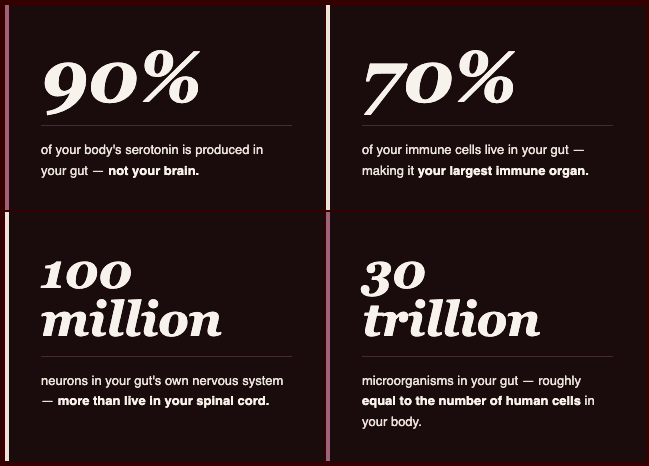
Serotonin is the neurotransmitter most people associate with mood. But about 90% of your body's serotonin isn't made in your brain — it's made in specialized cells lining your intestines called enterochromaffin cells.
Gut-derived serotonin doesn't cross the blood-brain barrier, so it isn't directly responsible for mood the way brain-derived serotonin is. But it regulates motility (how food moves through your digestive tract), influences appetite, and sends signals up to the brain via the vagus nerve. When your gut is inflamed or overrun by the wrong bacteria, that signaling gets disrupted and the downstream effects show up as low mood, poor sleep, constipation, or inflammation.
Translation: "fix your gut to fix your mood" isn't a wellness slogan. It's mechanism.
2. Your gut has its own nervous system
The enteric nervous system (ENS) is a network of more than 100 million neurons embedded in the lining of your gastrointestinal tract. That's more neurons than live in your spinal cord. It can operate independently of the brain, which is why scientists call it your "second brain."
The ENS runs digestion on its own, but it also talks constantly to your central nervous system through the vagus nerve. Roughly 80–90% of vagus nerve fibers carry signals from the gut to the brain, not the other way around. Your gut is doing more talking than listening.
3. About 70% of your immune system lives in your gut
The gut-associated lymphoid tissue (GALT) houses approximately 70% of your body's immune cells. That makes the gut lining the single largest immune organ you have.
When the gut barrier is compromised (sometimes called "leaky gut,") undigested food particles, bacterial fragments, and toxins can slip into the bloodstream. The immune system reacts. Chronic, low-grade inflammation follows. Over time, that's the soil for autoimmune flares, new food sensitivities, eczema, and the kind of fatigue that doesn't respond to more sleep.
4. Your gut bacteria help regulate your estrogen
Inside your microbiome lives a specific group of bacteria called the estrobolome. These are microbes that decides how much estrogen gets recycled back into circulation versus excreted.
When the estrobolome is balanced, estrogen stays where it should. When it's disrupted — by antibiotics, chronic stress, alcohol, or dysbiosis — estrogen can get reabsorbed in excess (contributing to PMS, heavy periods, fibroids, breast tenderness) or excreted too aggressively (contributing to low-estrogen symptoms).
If you're a woman in your 30s or 40s wondering why your hormones feel off "for no reason," your gut is one of the first places to look.
5. Your gut lining rebuilds itself every 3–5 days
The cells that make up the inner lining of your small intestine called enterocytes turn over roughly every 3 to 5 days. That's one of the fastest rates of cellular regeneration in the body.
The good news: this means you can meaningfully shift gut health in weeks, not years. The other good news, depending on how you take it: whatever you're eating, drinking, and stressing over right now is actively shaping the lining you'll be working with next week.
6. Your gut bacteria make neurotransmitters — including GABA and dopamine
Specific strains of gut bacteria produce neurotransmitters directly:
Lactobacillus species produce GABA, the calming neurotransmitter targeted by anti-anxiety medications
Bacillus species produce dopamine
Escherichia and Streptococcus species produce serotonin precursors
Bifidobacterium species help regulate tryptophan metabolism — the building block of serotonin
Your microbiome composition isn't a passive backdrop. It's an active producer of the chemicals your brain runs on.
7. Your gut microbiome contains ~30 trillion microorganisms
By cell count, you are more microbe than human. Estimates put the number of bacteria in your gut at roughly 30–40 trillion, comparable to the number of human cells in your body, representing more than 1,000 species.
That microbial community influences how you extract calories from food, how you respond to medication (including hormonal birth control and antidepressants), how reactive your immune system is, and even what foods you crave.
8. Stress changes your gut microbiome within hours
You don't have to have a chronic illness to disrupt your gut. Acute stress like a deadline, a bad night's sleep, an argument, etc. measurably shifts microbiome composition within hours. Cortisol changes gut motility, reduces secretory IgA (your gut's first immune defense), and creates conditions that favor opportunistic bacteria over beneficial ones.
This is one reason high-cortisol women often have parallel digestive issues: bloating, irregular bowel movements, food sensitivities that didn't used to exist. The gut and the stress response are not separate systems.
9. Your gut influences body composition
Gut bacteria help regulate how much energy you extract from food, how your body produces and responds to GLP-1 (the same hormone targeted by medications like semaglutide and tirzepatide), and how stable your blood sugar stays between meals. Certain microbial profiles are associated with leaner body composition; others with weight gain that doesn't respond to typical diet and exercise interventions.
If you've been doing "everything right" and your body isn't responding, the variable you haven't tested may be living in your gut.
Why this matters for women in their 30s and 40s
Most women in this stage of life have been told their symptoms are normal — the cost of having had kids, of getting older, of being busy. They're not normal. They're signals.
Bloating that won't quit. Sleep that doesn't restore you. PMS that's gotten worse. Anxiety that crept in without an obvious cause. A body that used to respond to effort and now just doesn't. Each of these has a plausible gut-mediated explanation. Standard bloodwork won't catch most of them, because standard bloodwork wasn't designed to.
A functional stool test was.
What a GI-Map test actually tells you
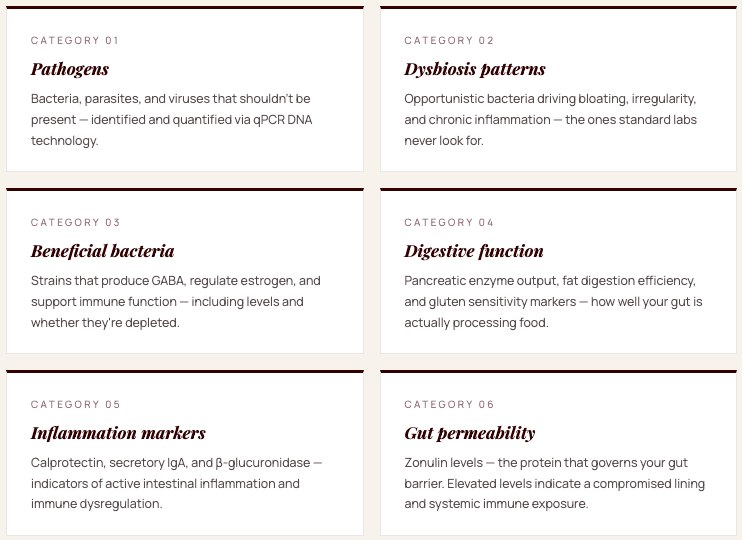
The GI-Map is the test we use at SeshDx because it's comprehensive and clinically actionable. It uses qPCR DNA technology to identify and quantify:
Pathogenic bacteria, parasites, and viruses that shouldn't be there
Opportunistic bacteria and dysbiosis patterns that explain bloating, irregularity, and inflammation
Beneficial bacteria levels — including the strains that produce GABA, regulate estrogen, and support immune function
Markers of digestive function — pancreatic enzyme output, fat digestion, and gluten sensitivity
Markers of intestinal inflammation and immune activity — calprotectin, secretory IgA, β-glucuronidase
Intestinal permeability markers — including zonulin, the protein that regulates the gut barrier
You collect the sample at home. Our team interprets the results clinically. You get a protocol built specifically for what your gut is actually doing, instead of another generic gut-health regimen.
Your gut is doing way more than you give it credit for
Your gut is not just digesting food. It is making most of your serotonin, talking to your brain, training your immune system, regulating your hormones, and influencing how your body uses every calorie you eat. If something feels off and nothing else has explained it, the gut is the most undervalued place to look.
You don't have to guess. You can test.
Ready to find out what your gut is actually doing?
A clinical-grade stool test, analyzed by Shae herself, with a protocol built around your results.
Frequently asked questions
Does your gut really make 90% of your body's serotonin?
Yes. Roughly 90% of the body's serotonin is produced by enterochromaffin cells in the lining of the gut. This gut-derived serotonin doesn't cross into the brain directly, but it regulates gut motility, appetite, and signaling to the brain via the vagus nerve.
Can gut health affect mood and anxiety?
Yes. Gut bacteria produce neurotransmitters (including GABA, dopamine, and serotonin precursors), and the vagus nerve carries signals from the gut to the brain. Disrupted gut health is associated with low mood, anxiety, brain fog, and poor sleep.
What's the best test for gut health?
For most women, a comprehensive stool analysis like the GI-Map is the most clinically useful starting point. It identifies pathogens, dysbiosis, digestive function, inflammation, and intestinal permeability — all in a single panel.
How long does it take to improve gut health?
The gut lining regenerates every 3–5 days, so meaningful changes can occur in weeks. Broader microbiome shifts typically take 3–6 months of consistent protocol work.
Does stress affect the gut?
Yes — measurably and quickly. Acute stress can shift microbiome composition within hours by raising cortisol, slowing motility, and reducing secretory IgA.
What's the difference between the GI-Map and an at-home microbiome test?
The GI-Map is a clinical-grade qPCR DNA test that quantifies specific organisms and includes inflammation, immune, and digestive markers — not just a microbiome snapshot. Most direct-to-consumer microbiome tests don't include the clinical markers that drive an actual protocol.