Most gut problems don't show up looking like gut problems. Brain fog, adult acne, anxiety that comes out of nowhere, worsening PMS, afternoon energy crashes, new food sensitivities, and stubborn body composition share a root cause more often than most women realize. Here's the mechanism behind each, and how a functional stool test like the GI-Map identifies the underlying driver in a single panel.
Most gut problems don't show up looking like gut problems.
The textbook version is bloating, gas, constipation, urgency. Those are the obvious ones. But the gut is the body's central regulator. It makes your serotonin, recycles your estrogen, governs ~70% of your immune function, and shapes your blood sugar response. When it's disregulated, the symptoms surface anywhere except where you'd look. (We covered the full mechanism in the last post on what your gut actually does.)
If you've been chasing seven different problems with seven different specialists, this is for you. Here are seven of the sneakiest gut-driven symptoms women in their 30s and 40s actually deal with — and what each one is most likely telling you.
1. Brain fog
You walk into a room and forget why. You're slower at finding words. You read the same paragraph three times. You can't seem to remember schedule that appointment.
Brain fog is one of the most reliable signals of gut dysfunction, and the mechanism is twofold. First, gut bacteria produce metabolites that, when the gut barrier is compromised, leak into circulation and cross the blood-brain barrier. The result is low-grade neuroinflammation.
Second, your gut produces the precursors to serotonin, dopamine, and acetylcholine which are the neurotransmitters responsible for focus and mental clarity. When microbiome composition is off, neurotransmitter production goes off with it.
If your brain fog gets noticeably worse after meals, that's an even stronger signal: digestion itself is generating systemic inflammation.
2. Adult acne (especially jaw, chin, or cystic)
You did acne in high school. You weren't supposed to have to do it again at 35.
Adult acne, particularly along the jawline, chin, and cystic, is rarely about your face. It's about your gut and the way your gut interacts with your hormones. Two mechanisms drive it.
First, the estrobolome — the bacteria in your gut that produce the enzyme that controls how much estrogen gets recycled back into circulation versus excreted. When it's disregulated, estrogen and androgens fall out of balance, and the skin shows it. Second, gut inflammation drives systemic inflammation, which manifests in the largest organ you have: your skin.
If your acne worsens premenstrually or tracks with specific foods, your gut and your hormones are talking to each other through your face.
3. Anxiety that came out of nowhere
You're not in a crisis. You didn't start a new job. Nothing happened. But something is off. Maybe a low-grade hum of anxiety that didn't used to be there.
This is one of the most under-recognized gut symptoms in women. Roughly 90% of your serotonin and a meaningful fraction of your GABA and dopamine are gut-mediated. The vagus nerve carries signals from the gut to the brain — about 80–90% of vagal traffic moves in that direction, not the reverse. When the microbiome is dysregulated or the gut barrier is permeable, the brain registers it as a threat.
The clinical phrase is "gut-brain axis dysfunction." The lived experience is feeling anxious and not knowing why.
4. Worsening PMS or new hormonal symptoms
Your cycle used to be predictable. Now it isn't. Your PMS used to last a day. Now it's a week. Your moods have a new shape.
This is the estrobolome again. When dysbiosis disrupts the gut bacteria that metabolize estrogen, the hormone either gets reabsorbed in excess, driving PMS, breast tenderness, heavy periods, and fibroids, or excreted too aggressively, driving low-estrogen symptoms like brain fog, sleep disruption, joint pain, and libido changes.
A DUTCH hormone test will tell you what your hormones are doing. A GI-Map will often tell you why.
5. Afternoon energy crashes
You wake up okay-ish. By 2 or 3 pm, you're done. You need caffeine, sugar, or a nap. Sometimes all three.
Afternoon crashes are usually framed as a blood sugar problem. They are, but the upstream cause is often gut-mediated. Your microbiome composition affects insulin sensitivity, GLP-1 production (the same hormone targeted by semaglutide and tirzepatide), and how stable your post-meal glucose curve is. Dysbiosis shortens the runway between meals.
Add chronic gut inflammation, which is metabolically expensive on its own, and the body simply runs out of energy in the afternoon.
6. New food sensitivities
Foods you've eaten your whole life now bother you. Dairy. Gluten. Eggs. Onions. The list keeps growing.
New food sensitivities almost always point to one of two issues: increased intestinal permeability ("leaky gut") or compromised digestive enzyme production. When the gut barrier is permeable, partially digested food particles cross into circulation, and the immune system flags them as foreign. When digestive enzyme output is low, foods aren't broken down enough for the body to recognize them as familiar.
The GI-Map measures both: zonulin (a marker of intestinal permeability) and pancreatic elastase (a marker of digestive enzyme output). The MRT Food Sensitivity Panel can add the immune piece.
7. Stubborn body composition
You're doing the things. The training, the sleep, the protein. Your body isn't responding the way it used to, or better said, the way it should.
The gut is one of the most overlooked variables in body composition. Specific bacterial profiles are associated with leaner phenotypes; others with weight gain that resists conventional intervention. The mechanisms stack: caloric extraction from food (some microbiomes pull more energy from the same meal), GLP-1 production (gut bacteria are direct regulators of this hormone), inflammation (chronic low-grade inflammation makes fat loss biochemically harder), and cortisol response (gut disregulation amplifies cortisol's effect on visceral fat).
If you've ruled out training, sleep, calories, and stress, your gut is the next variable.
What these symptoms have in common
The pattern is the gut. Different surface symptoms, same upstream system.
You can keep treating each one separately — a probiotic for the bloating, melatonin for the sleep, a topical for the skin, a stimulant for the focus, an antidepressant for the mood. Or you can find out what's actually happening at the root and work from there.
That's what a functional stool test is for.
How the GI-Map maps to these symptoms
The GI-Map identifies the specific drivers behind each of these symptoms in a single panel:
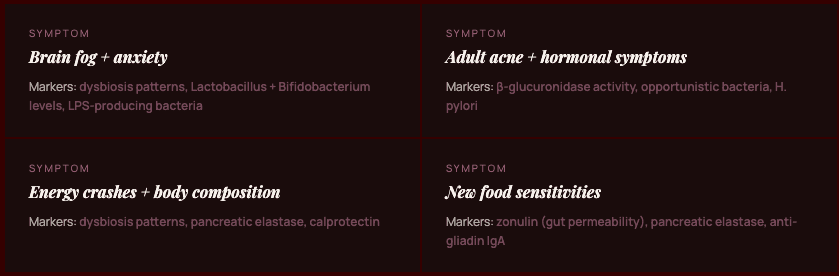
Brain fog, anxiety, mood — dysbiosis patterns, neurotransmitter-producing strains (Lactobacillus, Bifidobacterium), LPS-producing bacteria
Adult acne, hormonal symptoms — β-glucuronidase activity (the estrobolome marker), opportunistic bacteria, H. pylori
Energy crashes, body composition — dysbiosis patterns, digestive enzyme output (pancreatic elastase), inflammation markers (calprotectin)
Food sensitivities — intestinal permeability (zonulin), digestive function, gluten reactivity (anti-gliadin IgA)
Across all of them — pathogenic bacteria, parasites, fungi, and the inflammation and immune markers that quantify the impact
You collect the sample at home. Shae interprets the results clinically. You get a protocol built for what your gut is actually doing, not another generic gut-health regimen.
Get to the root-cause of your symptoms with a GI-Map
If you've been chasing symptoms in seven different directions and not finding traction, it's worth asking whether you're actually dealing with seven problems, or one root-problem with seven faces.
The gut is usually the answer.
Find out what's actually driving your symptoms.
A clinical-grade stool test, interpreted by Shae Davis, with a protocol built around your results.
Frequently asked questions
Can gut issues cause symptoms outside of digestion?
Yes. Because the gut regulates serotonin production, immune function, hormone metabolism, and inflammation, gut dysfunction can present as mood symptoms, skin issues, hormonal imbalances, fatigue, brain fog, and stubborn body composition — often without obvious digestive complaints.
Why do I have brain fog after eating?
Postprandial brain fog usually points to gut-mediated inflammation or impaired digestion. When the gut barrier is compromised, food-derived bacterial components and metabolites can enter circulation and trigger neuroinflammation. It can also reflect blood sugar disregulation downstream of microbiome imbalance.
Is adult acne related to gut health?
Often, yes — particularly jawline, chin, and cystic acne. The gut microbiome regulates estrogen metabolism via the estrobolome, and gut inflammation drives systemic inflammation that surfaces in the skin. Hormonal acne is usually a gut-and-hormone issue, not a skin issue.
Can gut problems cause anxiety?
Yes. Gut bacteria produce GABA, dopamine, and serotonin precursors, and the vagus nerve carries signals from the gut to the brain. Disrupted gut health is consistently associated with anxiety, low mood, and brain fog — even in the absence of digestive symptoms.
What test should I take if I think my symptoms are gut-related?
A comprehensive stool test like the GI-Map is the most clinically useful starting point. It quantifies pathogens, dysbiosis, digestive function, intestinal permeability, and immune markers in a single panel — enough to drive a targeted protocol.
Can gut issues affect weight loss?
Yes. The microbiome influences caloric extraction, GLP-1 production, insulin sensitivity, inflammation, and cortisol response — all upstream of body composition. Stubborn weight that resists training and nutrition changes is often gut-mediated.