The fatigue. The brain fog. The shallow sleep that never quite refills the tank. The body that won't respond the way it used to, no matter how clean you eat or how hard you train. You've probably been told some version of the same thing: this is just what your 30s and 40s feel like. Get used to it.
We're going to tell you something different, because it's true. What you're feeling isn't a character flaw, and it isn't permanent. It's a set of measurable declines in the molecules that actually run your cells. And most of them are fixable.
That's the whole premise of how we work. We don't optimize for survival. We optimize for healthspan, the number of years you feel like yourself, strong and clear and awake in your own life. The first step isn't a supplement or a prescription. It's finding out what's actually going on.
"Normal" isn't the same as optimal
Here's where most women get stuck. You go to your annual physical, your bloodwork comes back "normal," and you get sent home still exhausted. The problem is that a standard panel is built to catch disease, not to measure whether you're thriving. It checks if you're sick. It doesn't check if you're optimal. At that point, is it too late?
Said plainly: passing the test your doctor runs and feeling good are two different things. The markers that explain how you actually feel day to day, your cortisol rhythm, your sex hormones, your growth hormone, your cellular energy, usually aren't on that standard panel at all.
So you're left guessing. And guessing is exhausting in its own right.
What's actually declining
By your mid-30s, a few things start shifting at the same time, which is why it can feel like everything is going wrong at once.
Your cortisol curve flattens. Cortisol is supposed to be high in the morning to wake you up and low at night so you can sleep. Under chronic stress that rhythm gets blunted or flipped, which is exactly why you can be wired at 11pm and wrecked at 3pm on the same day.
Your sex hormones start to swing. Estrogen and progesterone don't fall in a tidy line, they fluctuate, and those swings drive mood, sleep, and the body composition changes that show up even when nothing about your effort has changed.
Your growth hormone drops. GH is part of how you recover, build and hold lean muscle, and sleep deeply. It declines steadily with age, and the deep, restorative stages of sleep go with it. Without deep sleep, GH supresses.
Your cellular energy production slows. The molecules your cells use to make energy become less available as you age. When that supply runs low, your cells can't make energy fast enough to keep up. That's the fog. That's the drained, run-down feeling that coffee doesn't touch. Less cell communication.
None of this is in your head. All of it is measurable. And once you can measure it, you can do something about it.
Start by seeing the truth: the DUTCH Test
You can't fix what you can't see, so this is where we usually begin. The DUTCH hormone and cortisol test maps your sex hormones and your full daily cortisol pattern, not a single snapshot but the actual curve across the day.
That means instead of guessing whether your hormones are "off," you get a real picture of where they are, how they're moving, and which symptoms they explain. Flat cortisol by mid-afternoon, low progesterone, a stalled metabolism: these stop being vague feelings and become numbers you can act on. Better yet, this test also shows how estrogen is being broken down and detoxified. This is something most doctors are not routinely evaluating.
From there we build a protocol around what we actually find, not a generic plan pulled off a shelf. Labs, then protocol, then results. If you're not sure where to start, this is the door we'd point you to first. (It isn't the only one. Some women start with the foundations of workouts and nutrition or a specific prescription therapy and test alongside it. But if you want clarity before anything else, start here.)
The molecules you can put back
Once you know what's declined, the conversation gets specific. Here are three of the therapies we reach for most, and what the evidence does and doesn't say about each.
NAD+: energy and focus when you're running on empty
NAD+ can help get your energy and focus back when you've been feeling consistently drained or run down. NAD+ is a molecule every cell uses to turn food into usable energy. As you age, you make less of it and burn through more, so the supply that keeps you sharp and awake quietly shrinks.
Said plainly: when NAD+ runs low, your cells can't make energy fast enough to keep up, and you feel it as fatigue and fog. Restoring it is about giving your cells the raw material to do their job again.
We're honest about the boundaries here. NAD+ has good support as it relates to energy, fatigue, and concentration. There's less evidence behind some of the broader metabolic and anti-aging claims you'll see floating around online, and we'd rather tell you that than oversell it. We offer it as a direct injection for the strongest, most reliable dose, a needle-free nasal spray, and a liquid oral dropper for a gentler entry point. Most women notice the difference over weeks rather than days.
Sermorelin: deeper sleep and real recovery
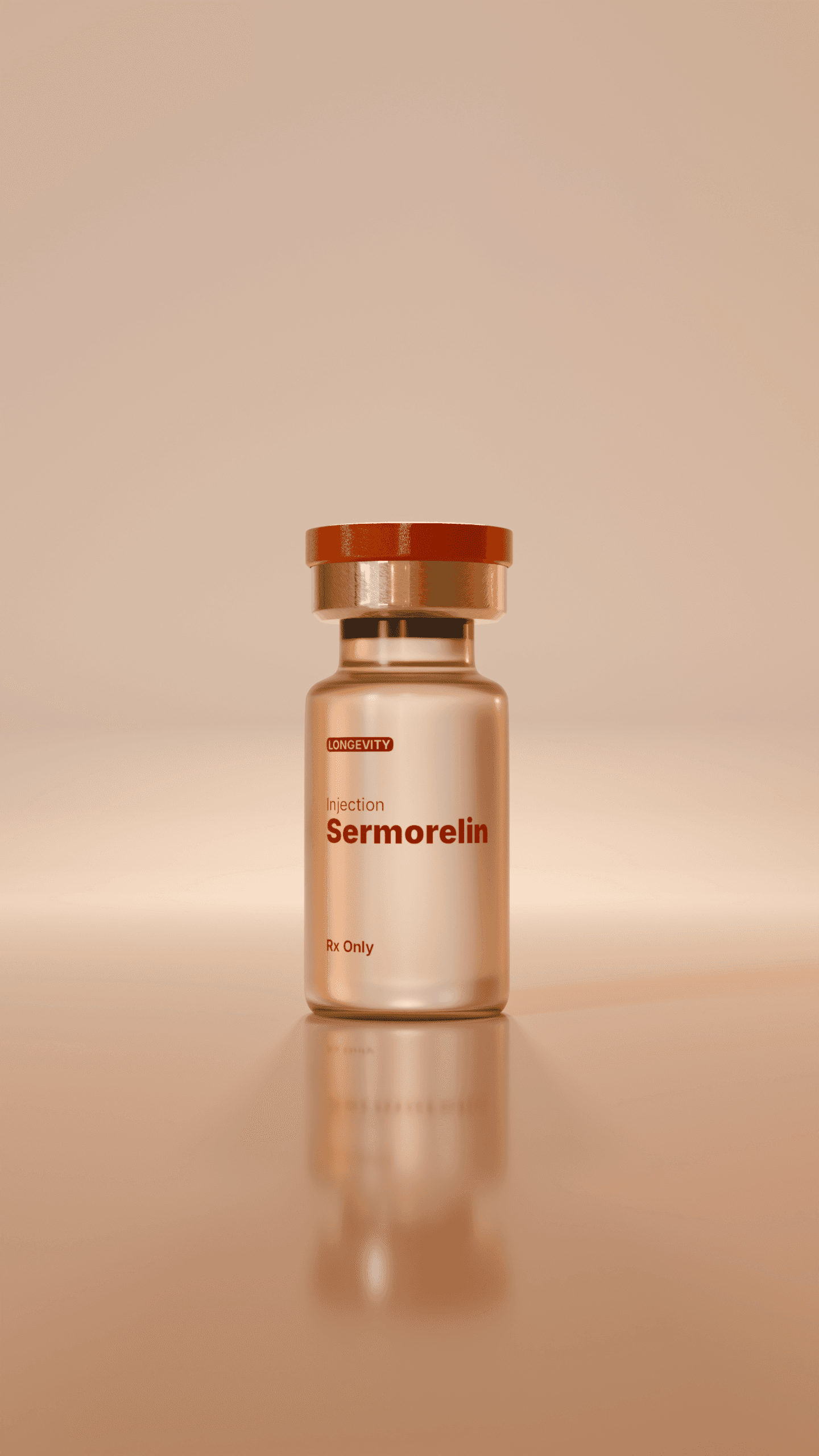
Sermorelin is a peptide that prompts your own body via messengers to release more growth hormone, the hormone tied to deep sleep, recovery, and holding lean muscle. Rather than replacing a hormone, it nudges your own system to produce more of what it's been making less of.
Said simply: better growth hormone signaling tends to show up first as deeper, more restorative sleep, then as better recovery and body composition over time. For a lot of women, it's the first time in years they wake up actually rested. This is a longer game, measured in weeks or months, not overnight, and it works best when we've confirmed it's right for you first.
Tirzepatide: when your body composition won't budge
If you're doing everything right and the scale and the mirror still won't move, Tirzepatide is one of the most effective tools we have. It works on the GLP-1 and GIP pathways that regulate appetite, blood sugar, and how your body stores and burns fuel.
That matters, because the story you've probably been told is that this is about discipline. It usually isn't. It's about signaling that shifted underneath you. When you correct the signal, the effort you're already putting in finally starts to count. And because we never want you to lose hard-earned muscle along the way, every metabolic protocol is paired with the training and nutrition to protect it.
Why we do it this way
A molecule on its own is a half-measure. What changes the outcome is the system around it.
When you start with SeshDx, you're guided by licensed clinicians and by Shae, our FDN-P functional nutrition practitioner, who reads your labs and builds the plan with you. You're never handed a prescription and left to figure it out alone. And every SeshDx customer gets complimentary access inside the Sesh Fitness App, the same five-star training and nutrition platform trusted by 500,000 women, because therapies work better when movement and nutrition are working with them. Movement is medicine. We mean that literally.
This is the part most of the industry skips. They sell you the molecule and call it a day. We test first, build the protocol around your actual numbers, give you the clinician and the coach, and put the training and nutrition behind it. That's the difference between a quick fix and a durable one. We're not after the version of you that feels slightly better for a month. We're after the version that lasts.
You don't have to accept feeling this way
The fatigue, the fog, the shallow sleep, the body that stopped cooperating. These aren't your new normal, and they aren't moral failures. They're signals. And signals can be read, measured, and changed.
So don't start with another guess. Start by understanding what's actually happening in your body. Order your diagnostic labs, see your real numbers, and let's build from there.
You, but optimal. Don't just survive. Thrive.
This article is for educational purposes and isn't medical advice. Whether a specific therapy is right for you is a clinical decision made with a licensed provider based on your history and labs. Individual results vary, and some therapies have stronger evidence behind certain benefits than others, which is why we test and review before we prescribe.