The Short Answer
The GI-MAP (Gastrointestinal Microbial Assay Plus) is a comprehensive stool test that analyzes the DNA of microorganisms living in your gut, like bacteria, viruses, parasites, fungi, and other pathogens, along with markers of gut immune function, intestinal permeability, inflammation, and digestive efficiency. It uses quantitative PCR (qPCR) technology to identify and measure specific microorganisms with greater precision than traditional stool cultures. It's one of the most comprehensive gut health assessments available and is used in functional medicine to identify root-cause contributors to a wide range of symptoms, from digestive complaints to hormonal imbalances, immune dysfunction, skin issues, and mood disturbances.
Why Standard Gut Testing Falls Short
If you've ever brought up gut concerns to a conventional provider, you've likely encountered one of two responses: a breath test for H. pylori if you have ulcer-like symptoms, or a referral to a gastroenterologist if your symptoms are severe enough to warrant endoscopy.
What you probably haven't received is a comprehensive map of everything living in your gut, in what quantities, and how your gut immune system is responding to it.
Traditional stool culture testing (the kind done in most clinical labs) grows microorganisms in culture media to identify them. This approach misses the majority of gut microbiome because many microorganisms can't be cultured in standard lab conditions. It's also slow (days for results) and primarily designed to identify acute infections, not the chronic dysbiosis patterns that drive many functional health complaints.
The GI-MAP uses a different technology; quantitative polymerase chain reaction (qPCR), which detects and quantifies the DNA of microorganisms directly from a stool sample. This means organisms that can't be cultured can still be identified and measured. The result is a dramatically more complete picture of what's actually in your gut.
What the GI-MAP Measures
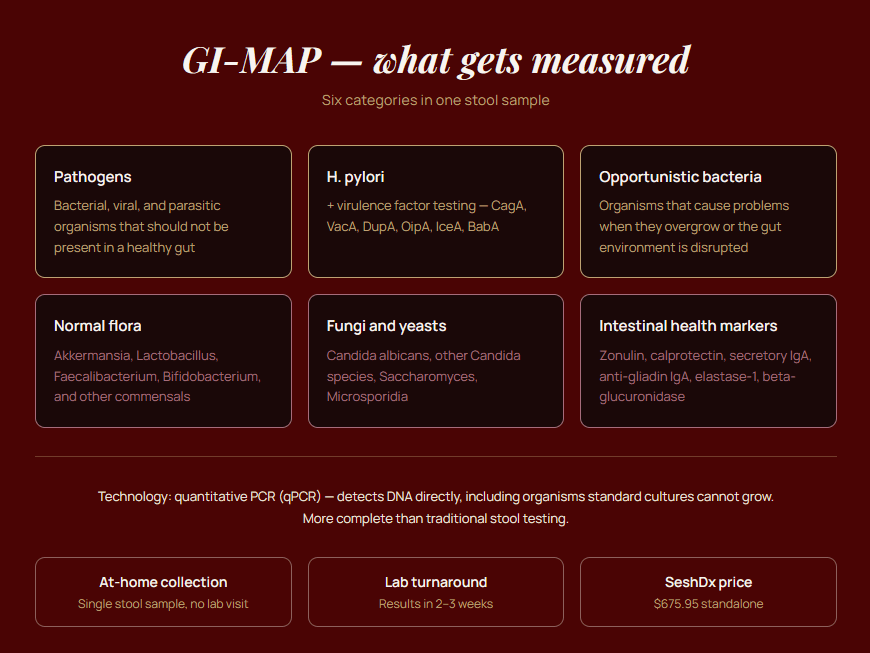
The GI-MAP organizes its findings into several major categories:
1. Pathogens
Bacterial, viral, and parasitic organisms that should not be present in a healthy gut, or should only be present in very small amounts. Pathogens detected by the GI-MAP include:
Bacterial pathogens:
H. pylori (with virulence factor testing — some strains are more aggressive than others)
Salmonella, Campylobacter, Shigella, STEC (Shiga toxin-producing E. coli)
C. difficile (Clostridioides difficile) — the toxin-producing strain responsible for antibiotic-associated diarrhea
Klebsiella pneumoniae, Proteus mirabilis, and other opportunistic bacteria
Parasitic pathogens:
Giardia duodenalis
Cryptosporidium
Entamoeba histolytica
Viral pathogens:
Adenovirus 40/41, Norovirus GI/GII
Many of these pathogens are missed by standard stool testing and can persist as low-grade chronic infections that produce subtle but persistent symptoms (bloating, irregular bowels, fatigue, immune disruption) without ever presenting as an acute illness.
2. H. pylori with Virulence Factors
H. pylori deserves its own category because of how commonly it's missed and how significantly it affects health beyond the stomach. H. pylori infects an estimated 44% of the global population, many of whom are asymptomatic carriers.
H. pylori doesn't just cause ulcers, it disrupts stomach acid production (contributing to low stomach acid and downstream digestive dysfunction), affects nutrient absorption (particularly iron, B12, and magnesium), and has been associated with insulin resistance, thyroid autoimmunity, and hormonal disruption.
The GI-MAP identifies H. pylori and tests for virulence factors (VacA, CagA, DupA, OipA, IceA, BabA) that determine whether the strain present is more or less likely to cause aggressive disease. Not all H. pylori infections are the same: virulence factor data matters for treatment decisions.
3. Opportunistic Bacteria
These are organisms that may be present in small amounts in a healthy gut but cause problems when they overgrow or when the gut environment is disrupted. Elevated opportunistic bacteria are associated with dysbiosis — imbalance in the gut microbiome — and are commonly found in women with:
Bloating and gas
Irregular bowels (both constipation and loose stools)
Brain fog
Skin issues
Hormonal imbalances (particularly estrogen-related, via the estrobolome)
Autoimmune conditions
Examples: Klebsiella pneumoniae, Morganella morganii, Pseudomonas aeruginosa, Staphylococcus aureus, and others.
4. Normal Bacterial Flora (Commensals)
This section measures key beneficial bacteria and important commensal organisms that should be present for healthy gut function. Low levels of protective bacteria are a significant finding, often more clinically significant than the presence of opportunistic ones.
Key bacteria measured include:
Akkermansia muciniphila — supports gut barrier integrity; low levels associated with metabolic dysfunction and increased intestinal permeability
Faecalibacterium prausnitzii — major anti-inflammatory bacterium; low levels associated with IBD, depression, and metabolic disease
Lactobacillus and Bifidobacterium species — foundational probiotic organisms
Bacteroides fragilis and others from the Bacteroidetes phylum
Knowing which beneficial organisms are depleted helps guide targeted probiotic and prebiotic recommendations rather than generic probiotic use.
5. Fungi and Yeasts
Fungal overgrowth — particularly Candida species — is one of the most over-diagnosed and simultaneously most under-tested gut conditions. The GI-MAP provides quantitative data on:
Candida albicans and other Candida species
Saccharomyces cerevisiae
Microsporidia and other fungi
Candida at elevated levels can disrupt gut barrier integrity, drive sugar cravings, contribute to brain fog, and interact with hormones… particularly cortisol and thyroid function.
6. Intestinal Health Markers
Beyond the microbial analysis, the GI-MAP includes several markers of gut function that are critical for interpreting the full picture:
Calprotectin — a marker of intestinal inflammation. Elevated calprotectin indicates active inflammation in the gut lining, associated with IBD and significant gut barrier disruption.
Zonulin — a protein that regulates tight junctions in the gut lining. Elevated zonulin is a marker of increased intestinal permeability ("leaky gut") — a condition in which the gut barrier becomes more permeable to bacterial components, undigested proteins, and other substances that shouldn't pass into the bloodstream.
Secretory IgA (sIgA) — the primary immune defense in the gut. Low sIgA indicates a depleted gut immune system that can't mount an adequate defense against pathogens. This is often found in chronically stressed women, as cortisol suppresses sIgA production.
Anti-gliadin IgA — measures immune reactivity to gliadin, a component of gluten. Elevated anti-gliadin IgA suggests gluten-triggered immune activation in the gut, even in the absence of a celiac diagnosis.
Elastase-1 — a pancreatic enzyme marker. Low elastase-1 indicates insufficient pancreatic enzyme output, meaning food (particularly protein and fat) isn't being broken down adequately. This leads to malabsorption, bloating, loose stools, and nutrient deficiency.
Beta-glucuronidase — an enzyme produced by certain gut bacteria that, when elevated, recirculates estrogens that were marked for elimination. Elevated beta-glucuronidase is directly linked to estrogen dominance, heavy periods, PMS, and higher breast cancer risk — a key gut-hormone connection.
What the GI-MAP Can Help Explain
The GI-MAP is useful for investigating a wide range of symptoms, including:
Chronic bloating, gas, or abdominal discomfort
Irregular bowels (constipation, diarrhea, or alternating patterns)
Diagnosed or suspected IBS or IBD
Unexplained fatigue that doesn't respond to sleep
Brain fog and cognitive symptoms
Skin conditions (acne, eczema, rosacea, psoriasis)
Hormonal imbalances, especially estrogen dominance
Recurring vaginal infections or bacterial vaginosis (gut dysbiosis affects vaginal microbiome)
Thyroid autoimmunity (gut health plays a role in triggering Hashimoto's)
Weight that won't shift despite diet and exercise
Mood disorders; the gut produces 90% of serotonin
Autoimmune conditions or suspected immune dysfunction
Reactivity to foods that has worsened over time
"The gut is rarely the first thing women are told to investigate when they're dealing with hormonal symptoms or fatigue. But I've seen the GI-MAP change the entire direction of someone's protocol. You find H. pylori that's been there for years, or a Candida overgrowth that's been driving sugar cravings and brain fog, and suddenly the picture makes sense in a completely different way." — Shae Davis, FDN-P, CPT, SeshDx
How the GI-MAP Is Done
The GI-MAP is an at-home stool test. You collect a stool sample using the provided collection kit and mail it back to the lab. There's no dietary prep required, no unpleasant bowel prep, and no lab visit needed. Results are typically returned within 2 to 3 weeks.
At SeshDx, all GI-MAP results are reviewed by Shae directly with you — going through each finding, explaining what it means in the context of your symptoms, and building a protocol around what the data actually shows.
The GI-MAP at SeshDx
The GI-MAP is offered at SeshDx for $675.95 as a standalone test. It's typically recommended for:
Women with persistent digestive symptoms
Women with hormonal imbalances that haven't fully resolved with hormone support
Women with skin conditions or autoimmune symptoms that may have a gut root
Women with unexplained fatigue, brain fog, or mood symptoms
Women who've done a hormone panel and want to understand the gut-hormone connection
The GI-MAP pairs particularly well with the DUTCH Complete — together they give you the full picture of both gut function and hormone metabolism, including the beta-glucuronidase/estrogen connection.
Frequently Asked Questions
How is the GI-MAP different from other gut tests like Genova's GI Effects? Both are comprehensive stool tests using PCR/DNA technology. The GI-MAP and GI Effects are the two most widely used functional gut assessments in the US. They have somewhat different marker sets and reference ranges. SeshDx uses the GI-MAP because of its strong clinical data on qPCR accuracy, its comprehensive virulence factor testing for H. pylori, and its inclusion of intestinal permeability (zonulin) and immune markers (sIgA) alongside the microbial analysis.
Do I need to change my diet before collecting the sample? No specific dietary restrictions are required. However, stopping probiotic supplements 5 to 7 days before collection is generally recommended to avoid artificially elevating probiotic organism counts.
Can I take the GI-MAP if I'm currently on antibiotics? No. Antibiotics will significantly alter test results. It's generally recommended to wait at least 4 weeks after completing antibiotic therapy before testing.
What happens if H. pylori is found? H. pylori treatment depends on the strain (virulence factors), your symptoms, and your clinical picture. Standard treatment involves a course of antibiotics — called triple or quadruple therapy — and eradication is typically confirmed with retesting 6 to 8 weeks later. Shae will walk you through the findings and coordinate treatment approach.
Can gut test results explain why probiotics haven't worked for me? Often, yes. Generic probiotic use without knowing your specific flora profile is guesswork. The GI-MAP shows you exactly which organisms are depleted and which are overgrown — allowing for targeted, specific recommendations rather than the standard "take a multi-strain probiotic."
The Bottom Line
The GI-MAP is a DNA-based, comprehensive stool analysis that measures pathogens, bacterial flora (both beneficial and opportunistic), fungi, intestinal inflammation, gut barrier integrity, and digestive function — in a single at-home stool collection. It's one of the most powerful diagnostic tools in functional medicine for identifying the gut-root contributors to a wide range of symptoms, including many that don't seem gut-related on the surface. At SeshDx, GI-MAP results are reviewed with you directly and used to build a targeted, protocol-driven response.
Order the GI-MAP Test at SeshDx →
This content is educational and does not constitute medical advice. Please consult a licensed healthcare provider before making changes to your health protocol.