The Short Answer
The DUTCH Complete (Dried Urine Test for Comprehensive Hormones) is an at-home hormone test that uses dried urine samples to evaluate sex hormones, adrenal hormones, cortisol patterns, hormone metabolites, melatonin, and select markers related to nutrient status, oxidative stress, and gut health.
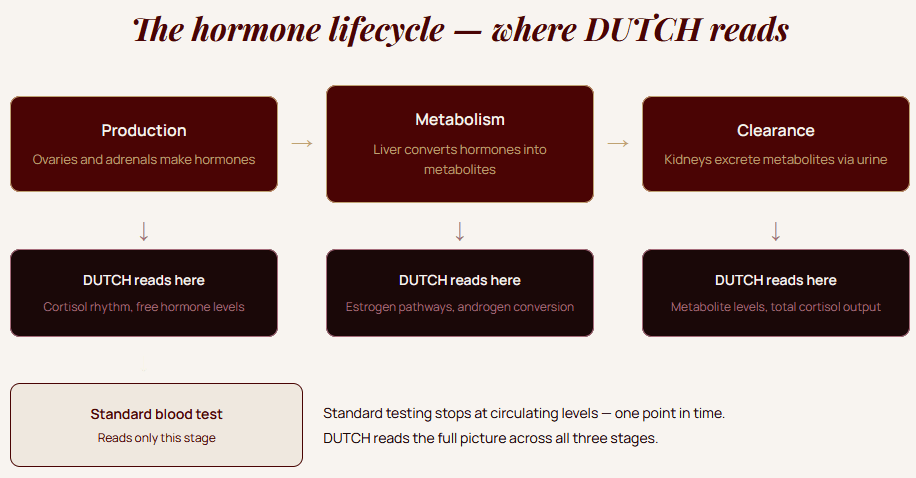
Unlike a single blood draw, which captures hormone levels at one point in time, the DUTCH test helps show how your body is producing, using, and metabolizing hormones across the day. That can make it especially helpful for women dealing with symptoms like fatigue, PMS, irregular cycles, acne, hair thinning, low libido, sleep issues, mood swings, perimenopause symptoms, and stress-related hormone changes.
Want to understand what your hormones are actually doing?
The DUTCH Complete Hormones + Cortisol Test is available through SeshDx for $645.95, with results reviewed in context by Shae so you are not left interpreting the data alone.
Order the DUTCH Complete Hormones + Cortisol Test →
Why Standard Hormone Testing Falls Short
If you have ever brought up hormone symptoms to a conventional provider, you may have heard some version of: “Your labs look normal.”
But you still feel off.
Maybe your periods are heavier than they used to be. Maybe your PMS feels intense. Maybe you wake up exhausted, crash in the afternoon, or feel wired at night. Maybe your skin, mood, libido, or weight changed and no one has been able to explain why.
Standard hormone testing can be useful. But it often gives an incomplete picture.
Many conventional labs look at hormone levels in the blood at one point in time. That can be helpful for certain diagnoses, but hormones are not static. Cortisol changes throughout the day. Progesterone changes after ovulation. Estrogen shifts across the cycle. And your body’s ability to metabolize and clear hormones can matter just as much as how much hormone you are making.
The DUTCH Complete gives a broader view. It looks not only at hormone levels, but also at hormone metabolites, cortisol rhythm, cortisol metabolism, and several related markers that can help explain why symptoms are happening in the first place.
What the DUTCH Measures
The DUTCH Complete organizes its findings into several major categories.
1. Estrogens and Estrogen Metabolites
Estrogen is not just one hormone. The DUTCH looks at different forms of estrogen and how your body is metabolizing them.
This includes:
Estrone, also known as E1
Estradiol, also known as E2
Estriol, also known as E3
Estrogen metabolites that show how estrogen is being processed and cleared
This matters because two women can have similar estrogen levels but very different estrogen metabolism patterns.
One woman may be making too much estrogen. Another may not be clearing estrogen efficiently. Another may be pushing estrogen down pathways that may be less favorable.
These patterns may help explain symptoms like PMS, heavy periods, breast tenderness, mood swings before your period, menstrual migraines, fibroids, endometriosis patterns, and perimenopause symptoms.
The goal is not to label estrogen as “good” or “bad.” Estrogen is essential. The goal is to understand whether your body is producing, processing, and clearing it well.
2. Progesterone
Progesterone is one of the most important hormones for cycle regularity, mood, sleep, and nervous system stability.
The DUTCH measures progesterone metabolites, which can help give insight into progesterone production during the luteal phase, the second half of the menstrual cycle after ovulation.
Low progesterone patterns may be connected to:
PMS
Spotting before your period
Short luteal phases
Poor sleep before your period
Anxiety or irritability before your period
Heavy or irregular bleeding
Progesterone is closely tied to ovulation. If ovulation is inconsistent, progesterone production often is too. That is why hormone symptoms are not always solved by “balancing hormones” in a general way. You have to understand what the pattern actually is.
3. Androgens: Testosterone, DHEA, and DHT Pathways
Androgens are often thought of as male hormones, but women need them too.
Healthy androgen levels support energy, motivation, muscle, libido, and metabolic function. But when androgens are too high, too low, or being converted down certain pathways, symptoms can show up quickly.
The DUTCH can provide insight into testosterone, DHEA, and androgen metabolites, including patterns related to DHT activity.
This can be helpful when investigating:
Acne
Oily skin
Hair thinning
Facial hair growth
Low libido
Low motivation
Difficulty building muscle
PCOS-like symptoms
This section is useful because androgen symptoms are not always about “high testosterone.” Sometimes the issue is how testosterone is being converted. Sometimes the pattern is adrenal. Sometimes it is ovarian. Sometimes it is connected to insulin, inflammation, or chronic stress.
4. Cortisol and Cortisone Rhythm
Cortisol is your primary stress-response hormone.
It should rise in the morning to help you wake up, then gradually decline throughout the day so your body can wind down at night.
The DUTCH Complete measures free cortisol and free cortisone at multiple points throughout the day, giving a picture of your daily cortisol rhythm. It measures sex hormones, cortisol levels, and their metabolites, along with markers related to nutritional deficiencies, oxidative stress, gut health, melatonin, and more.
This can help identify patterns like:
Low morning cortisol
Elevated evening cortisol
Flat cortisol rhythm
High or low cortisol output
Stress patterns that may affect sleep, energy, recovery, and hormone production
This matters because stress does not just live in your head. The stress response communicates with your reproductive hormones, thyroid function, blood sugar regulation, sleep-wake rhythm, inflammation, and immune function.
So when cortisol is dysregulated, it may show up as much more than “feeling stressed.”
It can look like waking up exhausted, crashing in the afternoon, feeling wired at night, struggling to recover from workouts, or feeling like your body is constantly bracing.
5. Cortisol Metabolism
The DUTCH does not only look at free cortisol, but also looks at metabolized cortisol.
This helps show how much cortisol your body is producing and clearing overall.
This distinction matters because someone may have low free cortisol and assume their body is not making enough cortisol. But in some cases, total cortisol production may be normal or high, while free cortisol appears low because of how the body is metabolizing or clearing it.
This can be helpful for women who feel:
Burned out
Wired but tired
Worse after intense exercise
Dependent on caffeine to function
Unable to recover despite rest
Exhausted even after sleeping
At SeshDx, cortisol markers are never interpreted in isolation. They are reviewed alongside symptoms, training load, nutrition, sleep, cycle history, stress, and other lab findings.
6. Melatonin, Oxidative Stress, and Organic Acid Markers
The DUTCH Complete also includes a targeted set of organic acid markers.
These do not replace a full organic acids test, but they can provide additional clues related to melatonin, oxidative stress, nutrient status, neurotransmitter metabolism, and gut health. The test looks at sex hormones and metabolites, diurnal free cortisol, total cortisol metabolites, and OAT markers related to nutritional deficiencies, oxidative stress, gut dysbiosis, melatonin, neuroinflammation, and more.
This section can help connect hormone symptoms to broader patterns in the body.
For example, poor sleep may not only be a cortisol issue. Mood changes may not only be a progesterone issue. Fatigue may not only be a thyroid issue. The body is connected, and these markers can help show where the stress load may be coming from.
What the DUTCH Can Help Explain
The DUTCH Complete may be useful for investigating a wide range of symptoms, including:
PMS or PMDD-like symptoms
Heavy, painful, or irregular periods
Breast tenderness before your period
Mood swings, anxiety, or irritability
Menstrual migraines or cyclical headaches
Acne, especially jawline or cyclical acne
Hair thinning or increased facial hair
Low libido
Fatigue that does not improve with more sleep
Afternoon energy crashes
Feeling wired at night
Insomnia or restless sleep
Perimenopause symptoms
Hot flashes or night sweats
Stubborn weight changes
Poor workout recovery
Burnout or stress intolerance
PCOS-like symptoms
“Most women are told their hormones are normal because the testing only looked at one small piece of the picture. The DUTCH helps us see the pattern: how hormones are being produced, how they are being metabolized, and how stress may be influencing the entire system. That is where the plan becomes more specific.” — Shae Davis, FDN-P, CPT, SeshDx
How the DUTCH Test Is Done
The DUTCH Complete is an at-home dried urine test.
You collect urine samples on filter paper strips at specific points throughout the day, allow them to dry, then mail them back to the lab. There is no blood draw, no lab visit, and no full 24-hour urine collection jug.
For cycling women, timing matters. Collection is usually timed during the luteal phase, when progesterone should be elevated. This is typically several days after ovulation and before your next period begins.
For women with irregular cycles, postmenopausal women, or women using hormone therapy, timing may vary. That is why it is important to follow the instructions provided with your kit and review any hormone medications, supplements, or cycle considerations before collecting.
At SeshDx, DUTCH results are reviewed with you directly. Shae walks through what the markers mean, how they connect to your symptoms, and what the next steps may look like from a nutrition, lifestyle, supplement, training, recovery, or clinical referral perspective.
The DUTCH Complete at SeshDx
The DUTCH Complete Hormones + Cortisol Test is offered through SeshDx for $645.95. It is typically recommended for women who want deeper insight into hormone patterns, especially when symptoms have not been fully explained by standard labs.
It may be a fit for:
Women with persistent PMS, irregular cycles, or painful periods
Women with suspected estrogen dominance or low progesterone
Women with acne, hair thinning, low libido, or PCOS-like symptoms
Women with fatigue, burnout, sleep issues, or stress-related symptoms
Women in perimenopause who feel like their body is changing quickly
The DUTCH pairs especially well with gut testing when symptoms suggest a gut-hormone connection. That is because hormone metabolism does not happen in isolation. Gut health, liver detoxification, inflammation, nutrient status, stress, sleep, and blood sugar regulation can all influence how hormones are produced, metabolized, and cleared.
Ready to look deeper at your hormone patterns?
Order the DUTCH Complete Hormones + Cortisol Test →
Not sure? Take the quiz to see which lab is right for you →
Frequently Asked Questions
Is the DUTCH test better than blood testing?
Not exactly. It depends on what you are trying to understand.
Blood testing is useful and, in many cases, necessary. It can help evaluate circulating hormone levels and is often used in conventional diagnosis and medical monitoring.
The DUTCH test provides a different kind of information. It looks at hormone metabolites, cortisol rhythm, cortisol metabolism, and certain organic acid markers that are not usually included in standard bloodwork.
The best test depends on the question being asked.
Can the DUTCH diagnose PCOS, endometriosis, infertility, or perimenopause?
No. The DUTCH test is not used by itself to diagnose these conditions.
It can provide helpful information about hormone patterns that may be relevant to symptoms associated with these conditions, but diagnosis should always involve a licensed healthcare provider, appropriate clinical evaluation, and any necessary imaging or conventional labs.
Do I need to stop supplements or hormones before taking the test?
Possibly.
Some supplements, hormone therapies, and medications can affect results. You should follow the instructions provided with your kit and review your specific situation before collecting.
This is especially important if you are using progesterone, estrogen, testosterone, DHEA, pregnenolone, corticosteroids, hormonal birth control, or other medications that influence hormones.
Can I take the DUTCH if I am on hormonal birth control?
Yes, but interpretation will be different.
Hormonal birth control suppresses natural ovulation and changes endogenous hormone production. That means the DUTCH may not show the same type of cycle pattern you would expect from someone who is naturally ovulating.
This does not mean the test is useless. It just means the results need to be interpreted in the correct context.
What happens after I get my results?
At SeshDx, your results are delivered with explanations from Shae in a video you can go back and review as often as needed.
The goal is not to hand you a confusing lab report and leave you to figure it out alone. The goal is to connect the data to your actual life: your symptoms, your cycle, your stress, your training, your nutrition, your sleep, and your goals.
From there, Shae helps build a targeted plan based on what your results show.
The Bottom Line
The DUTCH Complete is an at-home dried urine hormone test that provides a deeper look at sex hormones, adrenal hormones, cortisol rhythm, cortisol metabolism, estrogen detoxification pathways, and select markers related to melatonin, oxidative stress, nutrient status, and gut health.
It is not a replacement for medical care, and it is not meant to diagnose conditions by itself.
But for women who feel dismissed, confused, or stuck after being told their labs are normal, the DUTCH can provide a more complete picture of what may be happening beneath the surface.
At SeshDx, the DUTCH is used as part of a bigger picture: symptoms, health history, lifestyle, training, stress, nutrition, cycle patterns, and functional lab data all working together to guide a more personalized protocol.
Order the DUTCH Complete Hormones + Cortisol Test at SeshDx →
This content is educational and does not constitute medical advice. Please consult a licensed healthcare provider before making changes to your health protocol.